)
)
)
-
Teams of AI agents can now plan, build, review and deploy software on their own. What makes them work well is accurate, up-to-date context, not bigger context windows.
-
A Git-based "company brain" keeps requirements, decisions, ownership and status in one place for agents to draw on.
-
Choosing which model handles each task should factor in cache rebuilding, latency and total cost. AI token spend has risen tenfold in seven months, so this matters.
-
Detailed tracking makes unpredictable agent behavior easier to trace and diagnose, and auditing every decision flags excessive permissions or unexpected actions.
-
Enterprises need security guardrails, human oversight, red teaming and the ability to step in as things happen.

Dr. Sambit Sahu, MVP, LLM Core & Agentic AI, Capital One; Krishna Gade, Founder & CEO, Fiddler AI, Arick Goomanovsky, Co-Founder & CEO, BAND; Vinay Kuruvila, CTO, Tinder; Zaid Kahn, Co-Founder & CEO, Neuron Factory

Sumeet Singh, Chief Data & AI Officer, Viasat
-
Agentic systems are very different from traditional enterprise stacks. Getting ready takes deliberate architectural change, and the models are not the hard part.
-
Viasat is moving in stages: from AI that assists, to automation, to an agentic workforce.
-
A governed lakehouse pulls scattered data together and builds trust, while an intelligence layer helps agents find reliable context across the business.
-
Agents do more than answer questions. They plan, use tools and write records, which raises the risk.
-
Readiness comes down to autonomy maturity. Start with retrieval, then move carefully to orchestrated workflows, with governance built in throughout.
-
AI agents go beyond traditional assistants by reasoning through tasks, using tools and iterating on their actions to complete more complex work.
-
Persistent identity, memory and reusable skills allow agents to learn from experience and take on ongoing organizational responsibilities.
-
Jobs can be broken into tasks that AI can handle independently, tasks requiring collaboration, and work that remains best suited to people.
-
As compute and agent capabilities increase, organizations can make projects and workflows more intelligent, with agents helping maintain and coordinate them over time.
-
Trusted digital workers could take on persistent roles such as coordinating work and managing routine decisions, while escalating areas that require human judgement.
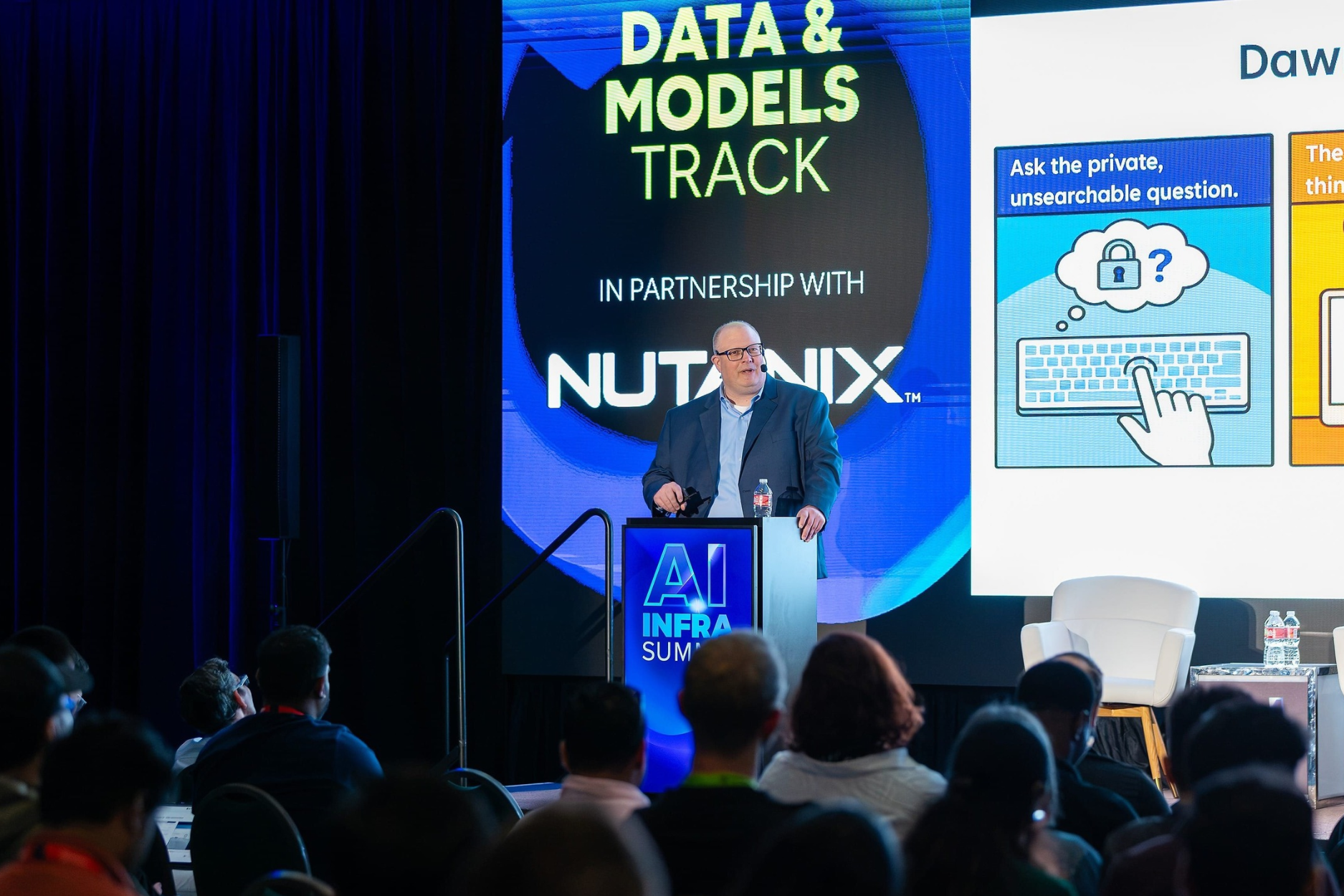
Donald Thompson, Distinguished Engineer, Microsoft

Shimon Ben-David, CTO, Weka
-
As AI adoption grows, inference and token costs are becoming a major concern, contributing to greater interest in hybrid cloud and on-prem infrastructure.
-
Model context windows have grown much faster than GPU memory, making memory capacity an increasingly important constraint for inference.
-
A large part of inference cost comes from repeatedly processing prompts and rebuilding the KV cache before generating new output.
-
More efficient attention techniques can reduce memory requirements, while metrics such as cost per token, tokens per watt and cache hit rates help measure efficiency.
-
Instead of repeatedly rebuilding context, token warehouses and context-aware routing can retain and reuse KV caches, reducing duplicated compute and improving inference economics.
-
Enterprise AI investments should focus on measurable business returns rather than expanding pilots without a clear path to value.
-
Measuring AI productivity requires new metrics that account for compute, tokens, and AI agents alongside traditional labor inputs.
-
AI value can progress from productivity improvements and cost savings to revenue growth and, ultimately, differentiated products and services.
-
Clear baselines and ongoing measurement are essential to connect AI-driven improvements to financial results and demonstrate their impact on the P&L.
-
As AI becomes more autonomous across enterprise workflows, organizations need strong governance, lifecycle management, and coordination between people and agents to scale its value safely.

Arun Nandi, Chief Data and AI Officer, Carrier