)
)
)

- Today’s AI lacks the common sense, reliability, and adaptability to operate safely in complex physical environments.
- Generalisation is essential: Physical AI must learn the task itself, rather than relying on environmental backgrounds or context seen during training.
- Compact “liquid networks” offer greater efficiency, explainability & generalisation than traditional large AI models.
- On-device models are essential, because cloud latency, server-scale compute & energy undermines safety.
- The future will be hybrid: most perception, planning, control & safety will run locally, with the cloud serving as a specialist or teacher.
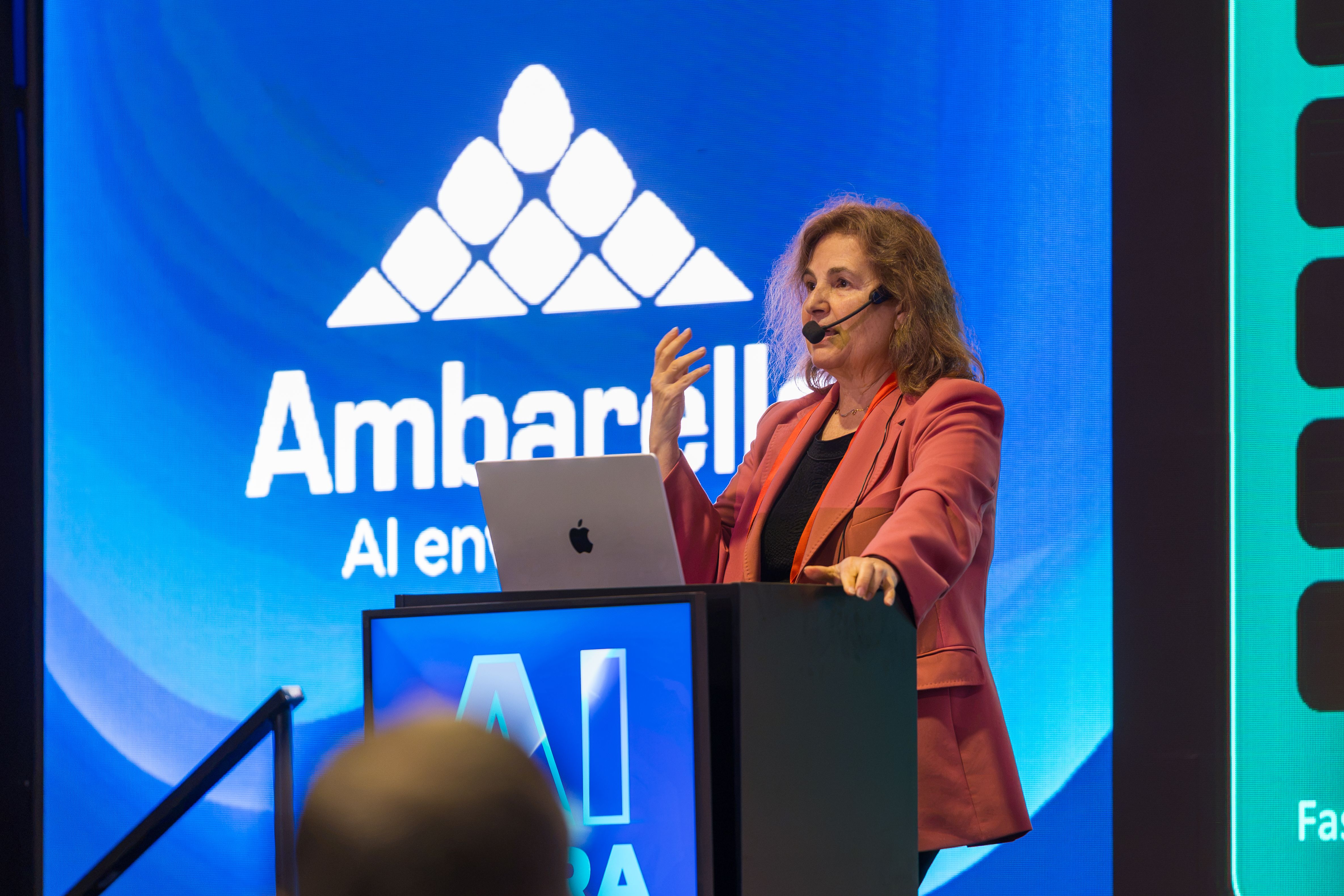
Daniela Rus, Director CSAIL, MIT
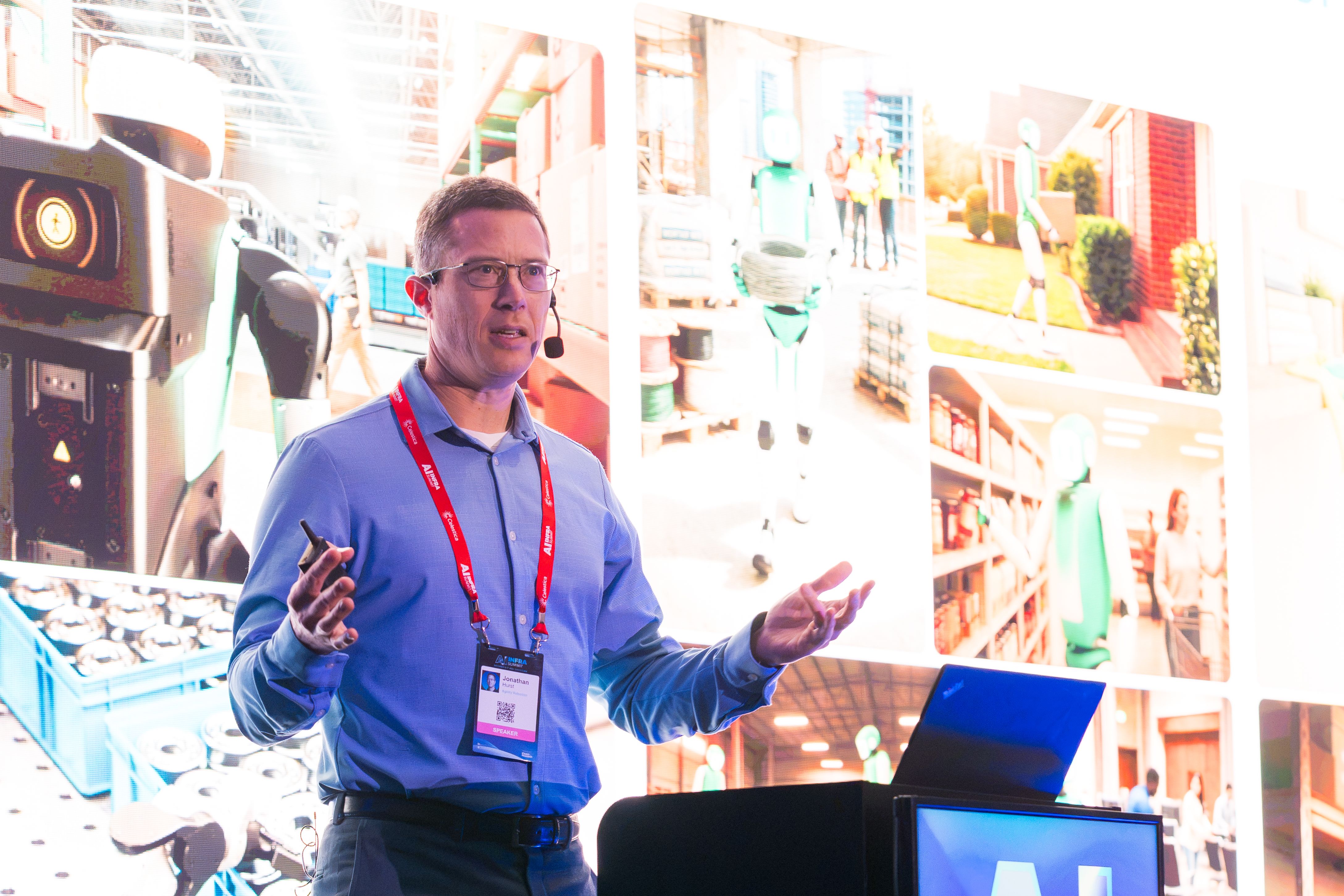
Jonathan Hurst, Co-Founder & Chief Robot Officer, Agility Robotics
- The humanoid form should be designed around human environments & tasks, not simply copy human features without a functional purpose.
- The ability for humanoids to work safely around humans, not robotic intelligence is the biggest barrier to deployment. We need reliable human detection & behaviour adaptation before robots can work without physical barriers.
- Robotic dexterity depends on compliant, force-controlled behaviour, not merely visually human-like five-fingered hands, which are currently being outperformed by two-fingered grippers.
- Hardware sets the limits of physical intelligence; software cannot compensate for manipulators that lack the required precision, strength & compliance.
- The path to general-purpose humanoid deployment starts with narrow industrial tasks, using real-world deployments to improve safety, manipulation & capability over time.
- Real world deployment data, including successes, failures, and operational context, is more valuable than increasing generic training data sets.
- More teleoperation data improves reasoning & control, but algorithms remain the fundamental bottleneck.
- Simulation is most valuable as part of a feedback loop, recreating deployment failures & testing alternative responses.
- Internet-scale data can provide broad world knowledge & behavioural priors, but cannot replace robot-specific data on contact, force & physical interaction.
- Robotics lacks reliable offline evaluation benchmarks, making field deployment essential for measuring true generalisation & performance.
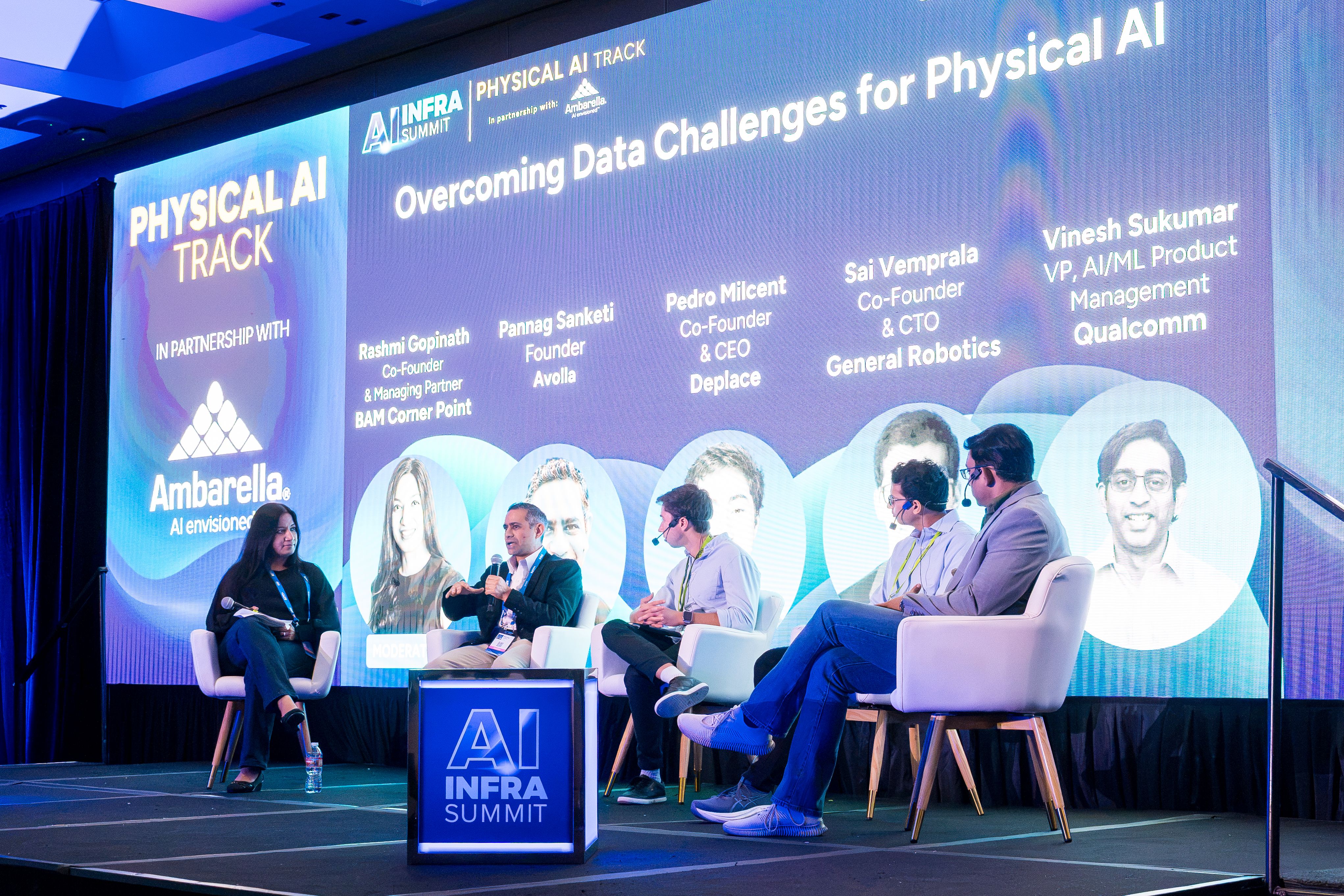
Rashmi Gopinath, Co-Founder & Managing Partner, BAM Corner Point; Vinesh Sukumar, VP AI/ML Product Management, Qualcomm; Pedro Milcent, Co-Founder & CEO, Deplace AI, Sai Vemprala: Co-Founder & CTO, General Robotics and Pannag Sanketi: Founder, Avolla

Ivan Poupyrev, Co-Founder & CEO, Archetype AI and Ethan Batraski, Partner, Venrock
- LLMs alone cannot understand the physical world, industrial deployment environments produce measurements such as current, voltage, and pressure, not language or video.
- Physical AI is expanding beyond robotics and existing machines, sensors, and connected edge devices represent an immediate and potentially larger deployment opportunity.
- Physical world models can learn through observation. By identifying repeatable behaviours, models can discover machine states & anomalies without prior knowledge of the equipment.
- Industrial Physical AI must run at the edge: data sensitivity, air-gapped environments & latency requirements make cloud-only deployments unsuitable for many applications.
- Intelligence compounds across connected assets: individual monitoring deployments can evolve into fleet optimisation, autonomous factories, and AI-assisted scientific discovery.
- Hybrid edge-cloud architectures should be selected case-by-case according to latency, cost, connectivity, quality & iteration needs.
- Safety-critical & real-time decisions must happen locally, while the cloud is better suited to model training, large-scale planning & deeper diagnostics.
- Physical AI scaling requires future-proof hardware, customer ROI & data flywheels that continuously improve models.
- Successful deployments create a flywheel: customer value drives wider adoption, producing more data that improves models & unlocks further use cases.
- No single model architecture solves every requirement; companies combine foundation models with specialised, internally developed models for behaviour, process control & skill selection.
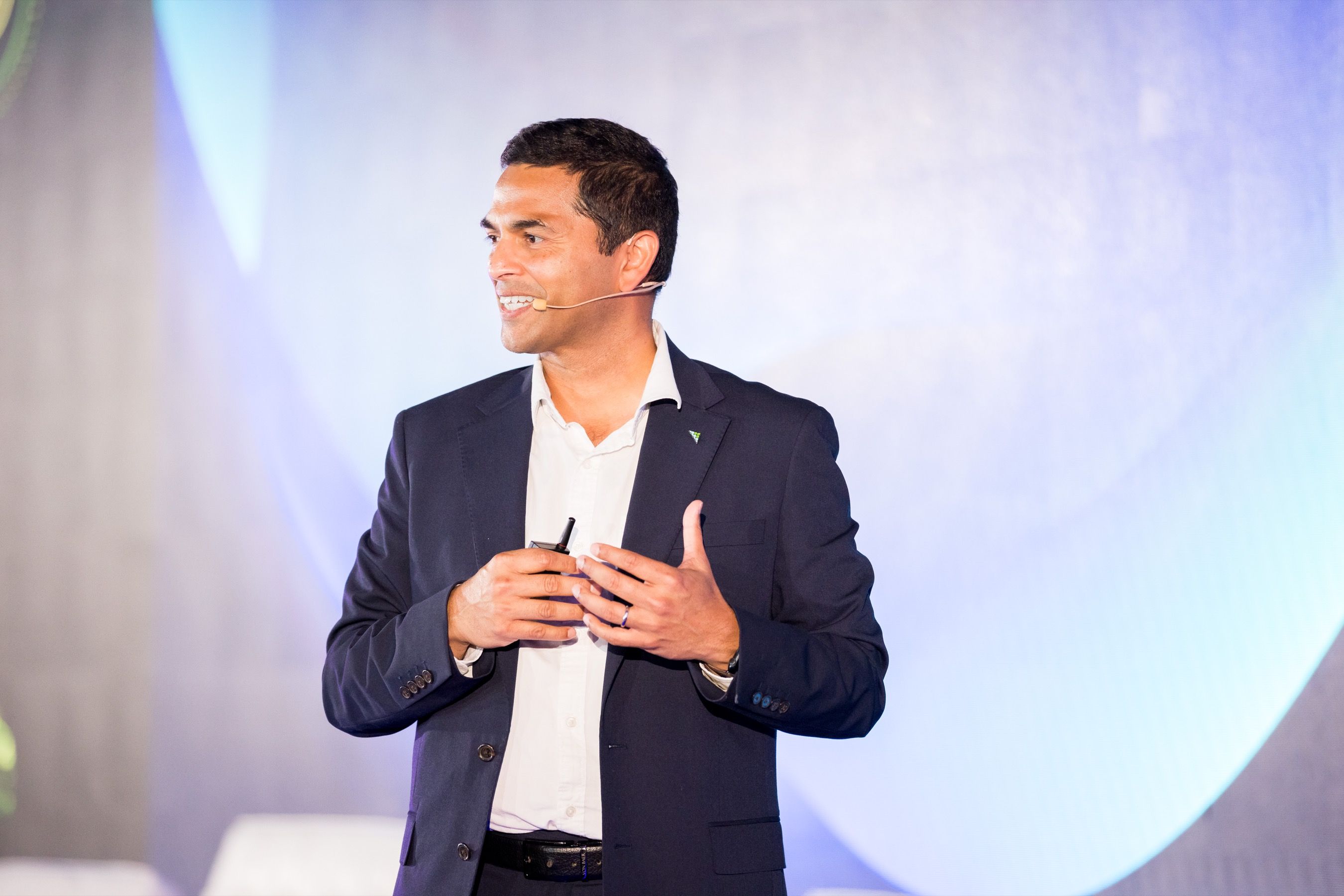
Muneyb Minhazuddin, Customer Growth Officer, Ambarella; David Gal, VP Product & Engineering – Connected Equipment, Samsara; SK Gupta, Co-Founder & Chief Scientist, GrayMatter Robotics; Kevin Peterson, Co-Founder & CTO, Bedrock Robotics